
I Just Want to Be Happy. Why Is It So Hard?
To my fellow human,
This blog is not meant to tell you how to be happy. It will not give you a five-step plan or a list of habits that will fix things. I wish it were that simple, though, haha!
What I do hope is that it gives you a moment to pause and question a few things about what we are told we should want and how we should feel. Whether the life we are chasing is one we chose, or one that was quietly chosen for us.
So many of us have ticked most of the boxes we were told to tick, worked hard, tried to maintain relationships, and kept up with the demands of daily life. And yet, underneath all of it, there is a quiet but persistent sense that something is not quite right. That everyone else seems to have figured out life that we have somehow missed. We have quietly picked up the message that we have to fit in, and we have to be happy. So, we are often driven by the desire to be happy and the desire to fit in, hoping it will lead to permanent contentment, harmony, and ease.
If that sounds familiar, you are not alone. You may simply be living inside a story about what life is supposed to feel like and look like that was never true to begin with.
“Why Does It Feel Like I Am Doing Everything Wrong?”
When our efforts don’t match the outcome. It does feel like we are doing something wrong. Much of the pressure we feel to be happy and functioning well comes not from within but from outside, from family expectations, social norms, the constant visibility of other people’s curated lives, and a culture that equates success with a particular kind of outward ease, called the problem of differentiation (Bowen, 1978).
So, living life the “right way ” looks like: abundant happiness and perfect harmony within ourselves, with others, and in life. The mental health field, perhaps unintentionally, reinforced this idea. From the 1960s, mental health practitioners began defining psychological well-being largely in terms of how well a person was functioning across their biological, psychological, and social domains. The absence of disorder, combined with high functioning across these areas, became the benchmark for a healthy life. This shift helped us understand dysfunction more clearly, but it left less room for the ordinary, messy, painful experiences that are simply part of being human. The gap between how we are told life should look and how it feels became a diagnosis rather than a normal part of human experience.
If permanent happiness and perfect harmony are unattainable, then perhaps instead of chasing a permanent destination, we can look for glimmers: small, fleeting moments where our nervous system finds safety, connection, or ease (Dana, 2020). A conversation that leaves us feeling seen. A brief quiet in the middle of an ordinary day. Real, meaningful, but temporary.
“Why Can’t I Just Deal with My Emotions Like a Normal Person?”
What is normal when it comes to emotions? If you go by what society tells us, normal looks like staying calm, keeping it together, and not letting feelings get in the way of functioning. We are rewarded for composure and quietly penalised for anything that looks like losing control. Even motivational culture sends the same message: be strong, push through, focus on action. Emotions are framed as obstacles to growth rather than information worth listening to.
The message most of us received was subtle, hidden, but consistent: having emotions requires justification, they should only last a short while, or better yet, they should not be visible at all. Deal with them quickly, quietly, and preferably alone.
Think about the last time you felt genuinely uncomfortable: sad, angry, anxious, disappointed, bored, or just empty. Now think about what you did next. Did you reach for your phone? Watch TV? Got busy with work? Told yourself to snap out of it and focus on whatever you were doing? Or did you let those emotions in and then feel intensely guilty and embarrassed for showing them? Most of us were never taught what to do with these feelings. So, we cannot identify, name, and work through them.
“What Is the Point of Feeling My Emotions If They Just Get in the Way?”
Your emotions are not obstacles. They are messengers. Research on the functional role of emotions consistently shows that each emotion carries a specific signal about what is happening and what we might need (Frijda, 1986; Greenberg, 2002).
Fear tells us something feels unsafe or threatening and prepares us to protect ourselves.
Anger tells us that something feels unjust, that a boundary has been crossed, or that a need has gone unmet.
Sadness tells us we have lost something that mattered and that we need time to grieve, rest, or be held.
Anxiety tells us we are uncertain about something important and that our system is on alert.
Guilt tells us we may have acted against our own values.
Shame tells us we believe something is fundamentally wrong with us, often a story that started long before now.
None of these are problems to be fixed. They are information. When we learn to slow down and listen to what the emotion is pointing to, rather than immediately silencing it, it becomes one of the most useful signals we have.
And here is something that might surprise you: even in the most extreme circumstances, our emotions continue to carry meaning. Two psychiatrists who were, in many ways, ahead of their time, Kazimierz Dabrowski and Viktor Frankl, dedicated their lives to understanding what human suffering and discomfort do to us. They are no longer with us, but what they left behind continues to change how we understand human pain, resilience, and growth.
Dabrowski called this positive disintegration (Dabrowski, 1964). The painful sense that your life does not fit who you are is not a sign that something has gone wrong. It is often the beginning of something more real.
Frankl observed, from inside Auschwitz, that what sustains people through the unthinkable is not the absence of pain but the presence of meaning (Frankl, 1959). People could bear almost anything when they understood why they were bearing it.
Furthermore, Research on post-traumatic growth found that a significant proportion of people who experienced serious adversity did not simply recover. They grew beyond where they had been before (Tedeschi & Calhoun, 1996). That idea always stays with me.
So, what we do with these emotions
and how we handle them helps us grow.
We get to decide whether we want to spend our energy controlling them and pushing them away or listening to them.
“So, If I Can’t Control My Emotions, What Should I Do with Them?”
Think about how much time, energy, and effort you have put into controlling your thoughts and emotions over the years. Has it worked? Unlikely, because it is impossible to control our thoughts and emotions. The only thing genuinely within our control is how we choose to spend our time and how we embrace these emotions and inner experiences.
If you have stayed with this blog all the way to here, that already says something. Here is something practical to take with you. The next time you notice yourself feeling stuck, reactive, or pulled toward a familiar pattern, try working through these four sections in order. Start with what you can observe on the outside and work your way inward.
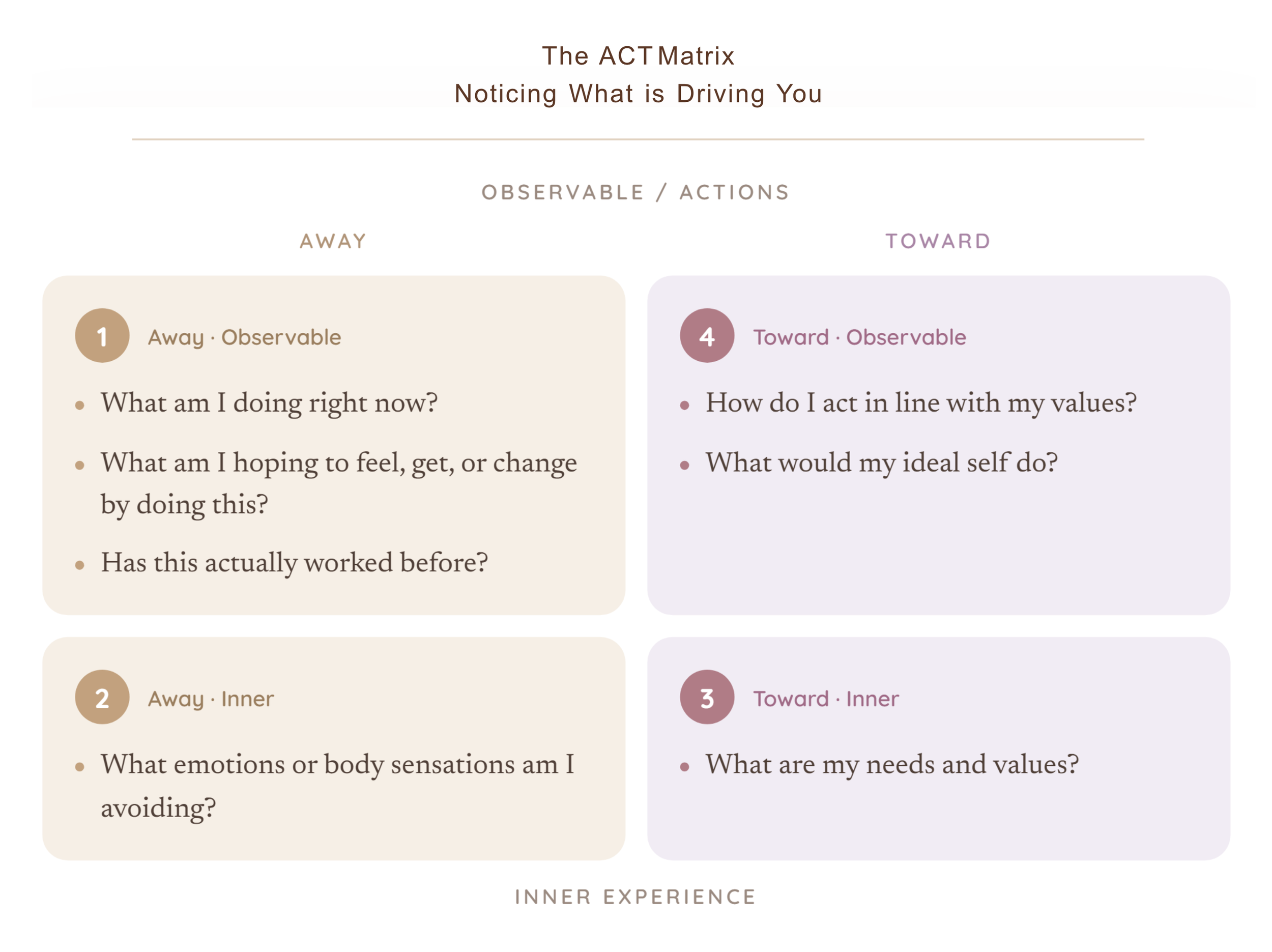
If the matrix brings up more questions than answers, or if you find it hard to identify what you are feeling or what you need, please be gentle with yourself. That is not a sign you are doing it wrong. That is a sign you might benefit from having someone walk alongside you, and a psychologist can help with exactly that. You are not alone in this journey.
And next time someone tells you to just let it go, or calm down, or just be happy, I hope you get to smile at that. Haha!
References
Bowen, M. (1978). Family therapy in clinical practice. Jason Aronson.
Dabrowski, K. (1964). Positive disintegration. Little, Brown and Company.
Dana, D. (2020). Polyvagal exercises for safety and connection: 50 client-centered practices. W. W. Norton & Company.
Frankl, V. E. (1959). Man’s search for meaning. Beacon Press.
Frijda, N. H. (1986). The emotions. Cambridge University Press.
Greenberg, L. S. (2002). Emotion-focused therapy: Coaching clients to work through their feelings. American Psychological Association.
Polk, K. L., & Schoendorff, B. (Eds.). (2014). The ACT matrix: A new approach to building psychological flexibility across settings and populations. New Harbinger Publications.
Tedeschi, R. G., & Calhoun, L. G. (1996). The posttraumatic growth inventory: Measuring the positive legacy of trauma. Journal of Traumatic Stress, 9(3), 455–471.
